Understanding Your Career Pathway

Early childhood care and education is a profession — with a pathway, a career ladder, and real opportunities to grow, earn more, and be formally recognized for what you know.What makes Maine's ECE pathway distinctive is that there is no single door in and no single route through. People come to this field from many different directions — straight out of high school through a Career and Technical Education program, through adult education, through a community partner organization, through college, or simply by showing up and starting work in a licensed program. Once you are in the field, the pathway forward has more than one route as well.

What Is a Career Pathway?

A career pathway is a map — and a plan. It shows you where you are in a profession right now, where you can go from here, and what it takes to get there.In early childhood care and education, a career pathway means there is a recognized progression from entry-level work all the way through advanced leadership and specialist roles. Each stage has a name, requirements you can meet, and formal recognition when you reach it. In Maine, professional growth on the pathway is also connected to financial reward — through the Early Childhood Educator Workforce Salary Supplement System, which ties your Registry level to your monthly pay.
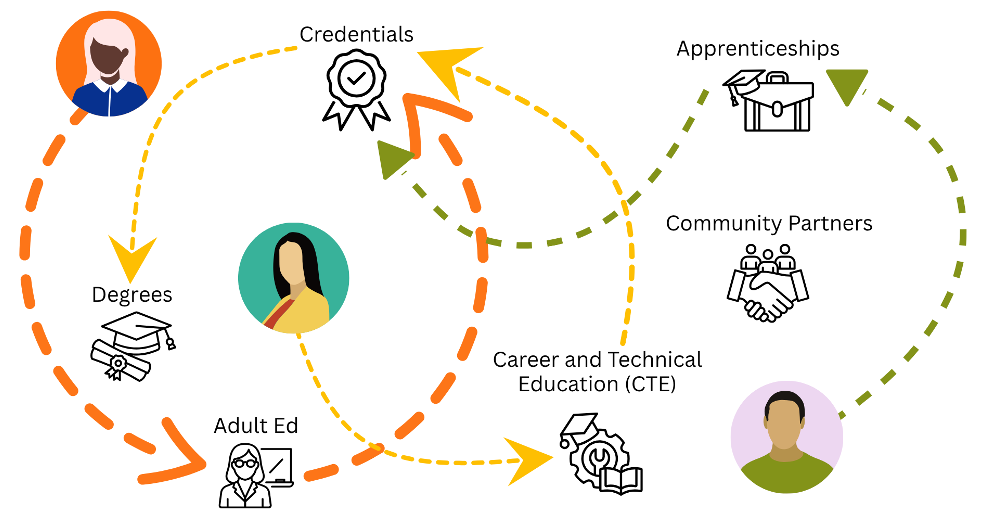
Diagram of multiple interconnected pathways into the early childhood education field, with dashed arrows weaving between options: Degrees, Credentials, Adult Education, Career and Technical Education (CTE), Apprenticeships, and Community Partners.

Some Ways People Enter the ECE Field

Click the titles to read more.

High school students in Maine can begin their ECE pathway through Career and Technical Education programs. CTE programs provide foundational knowledge and hands-on experience before graduation — and the credits and credentials earned there connect to the broader ECE professional development system.

Some people enter the field through a college or university program in early childhood education or a related field. An Associate's or Bachelor's degree provides a strong foundation for practice and may count toward credential eligibility and Registry advancement. If you are completing or have completed a degree program and are entering the field for the first time, you are already ahead on the pathway.

Adult Education programs across Maine provide a pathway for adults who are considering a career change or entering the workforce for the first time. If you are exploring early childhood care as a career through adult education, MRTQ PDN can help you connect your learning to the professional pathway.

Community organizations across Maine connect people to early childhood care as a career option and help them navigate the first steps. If you came to this page through a community partner, you are already on the pathway.

The Maine ECE Registered Apprenticeship Program is a structured, earn-while-you-learn pathway that supports newer practitioners through the credential process with the support of an experienced mentor. It is one of the most direct routes to a credential for someone who is already working in a licensed program.

Many people enter the field by finding a position in a licensed program and beginning to build their professional foundation from there. If that is where you are, you are already on the pathway.

How the Pathway Progresses

The ECE career pathway moves through recognizable stages. You may be at the beginning, somewhere in the middle, or ready to step into leadership — and the supports available to you look different depending on where you are.

You are new to the field or just starting to formalize what you know. This stage is about joining the Registry, completing your first Core Knowledge trainings, and beginning to build the professional record that the rest of your pathway is built on. The CECA credential — available through Career and Technical Education programs — is the entry-level credential for this stage.

You have experience in the field and you are ready to have Maine officially recognize it. This stage is about earning your first Direct Care Credential — Infant Toddler, Preschool, Youth Development, or Family Child Care — and advancing your Registry level and your wage supplement tier. The apprenticeship program is one of the most supported routes through this stage.

You are an experienced practitioner moving into a new setting, a new age group, or a specialized area of practice such as inclusion. This stage is about targeted training and credentials that build on what you already know rather than starting over.

You are ready to move beyond direct care into a formal leadership role. This stage is about the Director Credential and the skills required to lead a program — supporting staff, managing operations, building quality, and connecting your team to the professional development system that helps them grow.

You have deep expertise and you are ready to use it to develop others. This stage is about formally taking on the role of mentor, coach, consultant, or technical assistance provider — supporting newer practitioners, facilitating peer learning, and strengthening the field from the inside out. The Maine Technical Assistance Credential and the apprenticeship mentor role were built for people at this stage.

You are a director or program owner whose pathway is about the quality and stability of your whole team, not just your own professional growth. MRTQ PDN supports programs in building credentialed, stable workforces that strengthen Rising Stars ratings and program quality.

What Moves You Forward

  • Training

    Core Knowledge training builds the foundation for credential attainment and Registry advancement. Every training you complete is a step forward.

  • Credentials

    Maine credentials formally recognize your expertise at each stage of the pathway and advance your level in the Registry and the Early Childhood Educator Workforce Salary Supplement System.

  • College and University Education

    Degrees and coursework in early childhood education and related fields are recognized by the Maine Roads to Quality Registry and count toward your career lattice level. If you have a degree, make sure it is submitted to the Registry so your level accurately reflects your education.

Find Your Place on the Pathway

No matter how you entered the field or where you are right now, there is a next step. Find your journey below and click the title. 

Need Guidance?

Not sure where you fit? Contact us and we will help you find your place on the pathway.  mrtq.contact@maine.edu or 1-888-900-0055